Risk management
Organization of risk management
For FMO, acting in its role as Fund Manager (hereafter ‘FMO’) to be able to carry out the fund’s strategy, it is essential to have an adequate risk management system in place to identify, measure, monitor and mitigate financial risks. AEF (hereafter ‘the fund’) has a pre-defined risk appetite translated into limits for group, customer, country, region and currencies exposures. Limit usages are monitored on a monthly basis and for each proposed transaction.
The Fund Manager reviews each transaction and provides consent to eligible proposals. The Investment Committee, comprising of senior representatives of several departments, reviews financing proposals for new transactions. Each financing proposal is assessed in terms of specific counterparty, product risk as well as country risk and ESG risk. All financing proposals are accompanied by the advice of the Credit department. This department is responsible for credit risk assessment of both new transactions and the existing portfolio. For small exposures, Credit department has the authority to review new transactions.
In addition, customers are subject to a periodic customer review, which are in general executed annually. Exposures requiring specific attention are reviewed by the Financial Risk Committee (FRC). The large and higher risk exposures are accompanied by the advice of the Credit department. If the Financial Risk Committee concludes that a customer faces challenges in meeting payment obligations, those with loans are transferred to the Special Operations department, while those where the fund has equity exposure are transferred to the Private Equity department. There, they undergo intense monitoring as part of distressed asset management.
Capital management
The Fund aims to optimize development impact. This can only be achieved with a sound financial framework in place, combining a healthy long-term revolvability. The fund’s is based on a 100% contribution from the Dutch government. Total contribution to AEF from the Dutch government is €172.4 million on 31 December 2025 (31 December 2024: €160.0 million). Total Fund Capital – which is the sum of the contribution by the government, undistributed results from previous years, results from the current year, development contributions, and evaluations costs – decreased to €117.9 million in 2025 (2024: €137.4 million).
Financial risk
Credit risk
Definition
Credit risk is defined as the risk that the fund will suffer an economic loss because a customer fails to meet its obligations in accordance with agreed terms.
Risk appetite and governance
Adverse changes in credit quality can develop within fund’s emerging market loan portfolio due to specific customer and product risk, or risks relating to the country in which the customer conducts its business. The source of credit risk arises from investments in emerging markets and off-balance instruments such as loan commitments and guarantees.
Credit risk management is important when selecting and monitoring projects. In this process, a set of investment criteria per sector and product is used that reflects minimum standards for the required financial strength of FMO’s customers. Funding decisions depend on the risk profile of the customer and financing instrument. As part of regular credit monitoring, FMO customers are subject to annual reviews at a minimum. Customers that are identified as having financial difficulties fall under an intensified monitoring regime to proactively manage loans before they become non-performing, including quarterly portfolio monitoring meetings. The Special Operations department is responsible for actively managing the restructuring of distressed assets.
FMO has set internal appetite levels for non-performing exposures and specific impairments on loans. If any of the metrics exceed the appetite levels, Credit will assess the underlying movements and analyze trends per sector, geography, and any other parameter. Credit will also consider market developments and peer group benchmarks. Based on the analysis, Credit will propose mitigating measures to the FRC. If any of the indicators deteriorate further, the Risk department will be involved to assess to what extent the trend is threatening FMO’s capital and liquidity ratios.
Exposures and credit scoring
The Fund offers loans in emerging market countries. Diversification within the Fund’s portfolio is ensured through limits on individual counterparties (single client limit of €10 million), sectors and maximum tenor 25 years in debt transactions.
The following table shows AEF's total gross exposure to credit risk at year-end. The exposures, including derivatives, are shown gross, before impairments and the effect of mitigation using third-party guarantees, master netting, or collateral agreements. The maximum exposure to credit risk increased during the year to €132.7 million at year-end 2025 (2024: €121.7 million).
|
Maximum exposure to credit risk |
||
|
2025 |
2024 |
|
|
On balance |
||
|
Current account with FMO |
4,665 |
2,395 |
|
Short-term deposits |
13,121 |
12,931 |
|
Loans to the private sector |
||
|
- of which: Amortized cost |
54,675 |
48,720 |
|
- of which: Fair value through profit or loss |
15,828 |
16,512 |
|
Other receivables |
105 |
195 |
|
Total on-balance |
88,394 |
80,753 |
|
Off-balance |
||
|
Irrevocable facilities |
44,319 |
41,610 |
|
Total off-balance |
44,319 |
41,610 |
|
Total credit risk exposure |
132,713 |
122,363 |
Credit risk from loans arises from a combination of counterparty risk, country risk and product specific risks. These types of risk are assessed during the credit approval and credit review process and administrated via internal scorecards. The lending process is based on formalized and strict procedures. Decisions on authorizations depend on both the amount of economic capital and the risk profile of the financing instrument. For distressed assets, the Special Operations department applies an advanced workout and restructuring approach.
The CRR models are based on quantitative and qualitative factors and are different for respective customer types. The models for banks and non-banking financial institutions use factors including the financial strength of the customer, franchise value, and the market and regulatory environment. The model for corporates uses factors including financial ratios, governance, and strategy. The project finance model uses factors such as transaction characteristics, market conditions, political and legal environment, and financial strength of the borrower.
Based on these scores, FMO assigns ratings to each customer on an internal scale from F1 (lowest risk) to F20 (default) representing the probability of default. This rating system is equivalent to the credit quality rating scale applied by Moody's and S&P. Likewise, the loss given default is assigned by scoring various dimensions of the product-specific risk and incorporating customer characteristics. The probability of default and loss given default scores are also used as parameters in the IFRS 9 expected credit loss model. Please refer to the 'Significant accounting policies' section, for details of the expected credit loss calculation methodology.
Credit quality analysis
In addition to on balance loans, irrevocable facilities (off-balance) represent commitments to extend finance to clients and consist of contracts signed but not disbursed yet which are usually not immediately and fully drawn.
The following tables provide insights in the credit risk allocation of loan portfolio and loan commitments according to internal ratings.
|
Loans to the privat sector on December 31, 2025 |
Stage 1 |
Stage 2 |
Stage 3 |
Fair Value |
Total |
|
F1-F10 (BBB- and higher) |
- |
- |
- |
852 |
852 |
|
F11-F13 (BB-,BB,BB+) |
7,027 |
- |
- |
- |
7,027 |
|
F14-F16 (B-,B,B+) |
11,555 |
- |
- |
5,478 |
17,033 |
|
F17 -F19 (CCC+ , CCC, CCC-) |
- |
21,314 |
- |
1,500 |
22,814 |
|
F20 (CC) |
- |
- |
14,779 |
7,998 |
22,777 |
|
Sub-total |
18,582 |
21,314 |
14,779 |
15,828 |
70,503 |
|
Less: amortizable fees |
-284 |
-240 |
-168 |
- |
-692 |
|
Less: ECL allowance |
-197 |
-1,920 |
-4,501 |
- |
-6,618 |
|
Less: Fair value adjustments |
- |
- |
- |
-4,961 |
-4,961 |
|
Carrying value |
18,101 |
19,154 |
10,110 |
10,867 |
58,232 |
|
Loan commitments on December 31, 2025 |
Stage 1 |
Stage 2 |
Stage 3 |
Other 1) |
Total |
|
F1-F10 (BBB- and higher) |
- |
- |
- |
- |
- |
|
F11-F13 (BB-,BB,BB+) |
1,860 |
- |
- |
- |
1,860 |
|
F14-F16 (B-,B,B+) |
34,724 |
- |
- |
980 |
35,704 |
|
F17 -F19 (CCC+ , CCC, CCC-) |
- |
- |
- |
- |
- |
|
F20 (CC) |
- |
- |
6,755 |
- |
6,755 |
|
Sub-total |
36,584 |
- |
6,755 |
980 |
44,319 |
|
Less: ECL allowance |
-797 |
- |
-197 |
- |
-994 |
|
Carrying value |
35,787 |
- |
6,558 |
980 |
43,325 |
|
Loans to the privat sector on December 31, 2024 |
Stage 1 |
Stage 2 |
Stage 3 |
Fair Value |
Total |
|
F1-F10 (BBB- and higher) |
- |
- |
- |
625 |
625 |
|
F11-F13 (BB-,BB,BB+) |
- |
- |
- |
- |
- |
|
F14-F16 (B-,B,B+) |
11,449 |
1,331 |
- |
4,118 |
16,898 |
|
F17 -F19 (CCC+ , CCC, CCC-) |
- |
25,243 |
10,697 |
11,769 |
47,607 |
|
F20 (CC) |
- |
- |
- |
- |
- |
|
Sub-total |
11,449 |
26,574 |
10,697 |
16,512 |
65,232 |
|
Less: amortizable fees |
-324 |
-298 |
-73 |
- |
-695 |
|
Less: ECL allowance |
-185 |
-2,951 |
-2,467 |
- |
-5,603 |
|
Less: Fair value adjustments |
- |
- |
- |
-4,894 |
-4,894 |
|
Carrying value |
10,940 |
23,325 |
8,157 |
11,618 |
54,040 |
|
Loan commitments on December 31, 2024 |
Stage 1 |
Stage 2 |
Stage 3 |
Other 1) |
Total |
|
F1-F10 (BBB- and higher) |
- |
- |
- |
- |
- |
|
F11-F13 (BB-,BB,BB+) |
- |
- |
- |
- |
- |
|
F14-F16 (B-,B,B+) |
29,877 |
- |
- |
3,180 |
33,057 |
|
F17 -F19 (CCC+ , CCC, CCC-) |
6,763 |
- |
- |
- |
6,763 |
|
F20 (CC) |
- |
- |
- |
- |
- |
|
Sub-total |
36,640 |
- |
- |
3,180 |
39,820 |
|
Less: ECL allowance |
-485 |
- |
- |
- |
-485 |
|
Carrying value |
36,155 |
- |
- |
3,180 |
39,335 |
Non-performing exposures
A customer is considered non-performing when it is not probable that the customer will be able to pay his payment obligations in full without realization of collateral or calling on a guarantee, regardless of the existence of any past-due amount or the number of days past due.
NPE classifications are applied at the customer level, and such situations are considered to have occurred when one or more of the following conditions apply:
-
-
-
The customer is past due more than 90 days on any outstanding facility;
-
An unlikeliness to pay (UTP) trigger is in place that automatically leads to NPE;
-
An impairment analysis, done upon a UTP trigger that possibly leads to NPE, results in an impairment higher than 12.5% on any outstanding facility;
-
There are additional criteria for a customer to enter NPE status in case of Forbearance. If a customer with (No) Financial Difficulty - Forbearance status under probation is extended additional forbearance measures/ concessions or becomes more than 30 days past-due, it shall be classified as non-performing. This only applies if the customer has been non-performing while it was forborne.
-
-
NPE is applied at customer level.
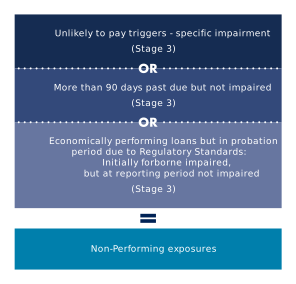
The Fund's NPE ratio increased from 27.9% (2024) to 32.3% (2025).
|
Loans past due and impairments 2025 |
|||||
|
Stage 1 |
Stage 2 |
Stage 3 |
Fair value |
Total |
|
|
Loans not past due |
10,712 |
21,314 |
8,848 |
15,828 |
56,702 |
|
Loans past due: |
|||||
|
-Past due up to 30 days |
7,870 |
- |
- |
- |
7,870 |
|
-Past due 30-60 days |
- |
- |
- |
- |
- |
|
-Past due 60-90 days |
- |
- |
- |
- |
- |
|
-Past due more than 90 days |
- |
- |
5,931 |
- |
5,931 |
|
Subtotal |
18,582 |
21,314 |
14,779 |
15,828 |
70,503 |
|
Less: amortizable fees |
-284 |
-240 |
-168 |
- |
-692 |
|
Less: ECL allowance |
-197 |
-1,920 |
-4,501 |
- |
-6,618 |
|
Less: fair value adjustments |
- |
- |
- |
-4,961 |
-4,961 |
|
Carrying value |
18,101 |
19,154 |
10,110 |
10,867 |
58,232 |
|
Loans past due and impairments 2024 |
|||||
|
Stage 1 |
Stage 2 |
Stage 3 |
Fair value |
Total |
|
|
Loans not past due |
9,250 |
29,604 |
4,161 |
16,512 |
59,527 |
|
Loans past due: |
|||||
|
-Past due up to 30 days |
2,199 |
-3,030 |
- |
- |
-831 |
|
-Past due 30-60 days |
- |
- |
- |
- |
- |
|
-Past due 60-90 days |
- |
- |
- |
- |
- |
|
-Past due more than 90 days |
- |
- |
6,536 |
- |
6,536 |
|
Subtotal |
11,449 |
26,574 |
10,697 |
16,512 |
65,232 |
|
Less: amortizable fees |
-324 |
-298 |
-73 |
- |
-695 |
|
Less: ECL allowance |
-185 |
-2,951 |
-2,467 |
- |
-5,603 |
|
Less: fair value adjustments |
- |
- |
- |
-4,894 |
-4,894 |
|
Carrying value |
10,940 |
23,325 |
8,157 |
11,618 |
54,040 |
|
Stage 3 loans - ECL distributed by regions and sectors |
||
|
At December 31, 2025 |
Energy |
Total |
|
Africa |
4,303 |
4,303 |
|
Asia |
95 |
95 |
|
Europe & Central Asia |
103 |
103 |
|
Total |
4,501 |
4,501 |
|
Stage 3 loans - ECL distributed by regions and sectors |
||
|
At December 31, 2024 |
Energy |
Total |
|
Africa |
2,322 |
2,322 |
|
Asia |
42 |
42 |
|
Europe & Central Asia |
103 |
103 |
|
Total |
2,467 |
2,467 |
Modified financial assets
Changes in terms and conditions usually include extending the maturity, changing the interest margin and changing the timing of interest payments. When the terms and conditions are modified due to financial difficulties, these loans are qualified as forborne. Refer to paragraph related to 'Modification of financial assets' in the Accounting Policies chapter.
The watch-list process and the Credit department review modified loans periodically. When a loan is deemed no longer collectible, it is written off against the related loss allowance. In 2025, there were no write-offs (2024: €5.6 million).
The following table provides a summary of the fund's forborne assets, both classified as performing and non-performing.
|
2025 |
|||
|
Loans to the private sector (Amortised Cost) |
Loans to the private sector (Fair value) |
Total |
|
|
Performing |
39,896 |
7,830 |
47,726 |
|
of which: performing but past due > 30 days and <=90 days |
- |
- |
- |
|
of which: performing forborne |
6,075 |
- |
6,075 |
|
Non-Performing |
14,779 |
7,998 |
22,777 |
|
of which: non-performing forborne |
4,176 |
2,178 |
6,354 |
|
of which: impaired |
14,779 |
- |
14,779 |
|
Gross exposure |
54,675 |
15,828 |
70,503 |
|
Less: amortizable fees |
-692 |
- |
-692 |
|
Less: ECL allowance |
-6,618 |
- |
-6,618 |
|
Less: fair value adjustments |
- |
-4,961 |
-4,961 |
|
Carrying amount at December 31 |
47,365 |
10,867 |
58,232 |
|
2024 |
|||
|
Loans to the private sector (Amortised Cost) |
Loans to the private sector (Fair value) |
Total |
|
|
Performing |
38,023 |
8,478 |
46,501 |
|
of which: performing but past due > 30 days and <=90 days |
- |
- |
- |
|
of which: performing forborne |
694 |
- |
694 |
|
Non-Performing |
10,697 |
7,279 |
17,976 |
|
of which: non-performing forborne |
4,148 |
2,127 |
6,275 |
|
of which: impaired |
3,795 |
- |
3,795 |
|
Gross exposure |
48,720 |
16,512 |
65,232 |
|
Less: amortizable fees |
-695 |
- |
-695 |
|
Less: ECL allowance |
-5,603 |
- |
-5,603 |
|
Less: fair value adjustments |
- |
-4,894 |
-4,894 |
|
Carrying amount at December 31 |
42,422 |
11,618 |
54,040 |
Equity risk
Definition
Equity risk is the risk that the fair value of an equity investment decreases. It also includes exit risk, which is the risk that the Fund’s stake cannot be sold for a reasonable price and in a sufficiently liquid market.
Risk appetite and governance
The fund has a long-term view on its equity portfolio, usually selling its equity stake within a period of 5 to 10 years. The fund can accommodate an increase in the average holding period of its equity investments and wait for markets to improve before pursuing an exit. The equity investment portfolio consists of direct investments, largely in the financial institutions and energy sectors, co-investments with aligned partners (mainly in cooperation with funds), and indirect investments in private equity funds. Equity investments are approved by the Investment Committee. In close cooperation with the Credit and Finance departments, the Private Equity department assesses the valuation of equity investments on a periodic basis, which are approved by the FRC. Diversification across geographical area, sector, and equity type across the total portfolio is evaluated before new investments are made. Based on this performance and the market circumstances, direct exits are pursued by involving intermediaries. In the case of co-investments, our fund managers initiate the exit process as they are in the lead. Exits are challenging due to the limited availability of liquidity in some markets and the absence of well-developed stock markets. The total outstanding equity portfolio including associates on December 31, 2025, amounts to €34.2 million (2024: €58.1 million).
Concentration risk
Definition
Concentration risk is the risk that the fund’s exposures are too concentrated within or across different risk categories. Concentration risk may trigger losses large enough to threaten the fund’s health or ability to maintain its core operations or trigger a material change in our risk profile.
Risk appetite and governance
Strong diversification within the fund’s emerging market portfolio is ensured through stringent limits on individual counterparties (single and group risk limits), sectors, countries, and regions. These limits are monitored by Risk, reviewed regularly, and approved by the FRC, the Managing Board, and the Supervisory Board. Diversification across countries, sectors, and individual counterparties is a key strategy to safeguard the credit quality of the portfolio.
The level of the country limits depends on the sovereign rating. FMO recognizes that the impact of country risk differs across the financial products it offers.
Country, regional and sector exposures
Country risk arises from country-specific events that adversely impact the Fund’s exposure in a specific country. Within FMO, country risk is broadly defined. It includes all relevant factors that have a common impact on the fund’s portfolio in a country such as economic, banking and currency crises, sovereign default and political risk events. The assessment of the country rating is based on a benchmark of external rating agencies and other external information.
The assessment of the country rating (F-rating scoring in line with internal credit risk rating) is based on a benchmark of external rating agencies and other external information. The average of the long-term foreign currency ratings of Moody’s, S&P and Fitch is used (debt and issuer rating). If none of the aforementioned ratings is available, then the average among OECD and IHS medium-term ratings is used.
The following tables present how the fund’s loan portfolio is concentrated according to country ratings. The comparison with FMO demonstrates that loan portfolio of the fund is concentrated in countries with higher ratings and is relatively prone to higher credit risk.
|
Overview country ratings |
||
|
Indicative external rating equivalent 2025 |
AEF (%) |
FMO-A (%) |
|
F9 and higher (BBB and higher ratings) |
1.3 |
4.7 |
|
F10 (BBB-) |
0.3 |
10.6 |
|
F11 (BB+) |
0.0 |
7.1 |
|
F12 (BB) |
0.0 |
19.8 |
|
F13 (BB-) |
0.0 |
13.6 |
|
F14 (B+) |
4.8 |
16.9 |
|
F15 (B) |
16.7 |
6.7 |
|
F16 (B-) |
23.9 |
11.8 |
|
F17 -F19 (CCC+ , CCC, CCC-) |
53.0 |
8.8 |
|
F20 (CC) |
0.0 |
0.0 |
|
Total |
100.0 |
100.0 |
|
Overview country ratings |
||
|
Indicative external rating equivalent 2024 |
AEF (%) |
FMO-A (%) |
|
F9 and higher (BBB and higher ratings) |
0.9 |
4.6 |
|
F10 (BBB-) |
0.6 |
8.8 |
|
F11 (BB+) |
0 |
3.8 |
|
F12 (BB) |
0 |
11.9 |
|
F13 (BB-) |
0 |
23.2 |
|
F14 (B+) |
3.8 |
9.2 |
|
F15 (B) |
4.3 |
10.9 |
|
F16 (B-) |
43.9 |
16.4 |
|
F17 and lower (CCC+ and lower ratings) |
46.5 |
11.2 |
|
Total |
100.0 |
100.0 |
|
Gross exposure of loan portfolio distributed by region and sector |
|||
|
Energy |
Multi-Sector Fund Investment |
Total |
|
|
At December 31, 2025 |
|||
|
Africa |
62,060 |
1,500 |
63,560 |
|
Asia |
1,390 |
- |
1,390 |
|
Latin America & the Caribbean |
- |
- |
- |
|
Europe & Central Asia |
- |
- |
- |
|
Non-region specific |
5,553 |
- |
5,553 |
|
Total |
69,003 |
1,500 |
70,503 |
|
At December 31, 2024 |
|||
|
Africa |
54,501 |
3,735 |
58,236 |
|
Asia |
1,684 |
- |
1,684 |
|
Latin America & the Caribbean |
- |
- |
- |
|
Europe & Central Asia |
114 |
- |
114 |
|
Non-region specific |
5,198 |
- |
5,198 |
|
Total |
61,497 |
3,735 |
65,232 |
Single and group risk exposures
In the fund risk appetite, the maximum customer exposure for AEF is set at €10 million.
Counterparty credit risk
Counterparty credit risk in the treasury portfolio stems from bank account holdings and placements in money market funds to manage the liquidity in the fund. The Risk department approves each obligor to which the fund is exposed through its treasury activities and sets a maximum limit to the credit exposure of that obligor. Depending on the obligor’s short and long-term rating, limits are set for the total and long-term exposure. The fund pursues a conservative investment policy.
Liquidity risk
Definition
Liquidity risk is defined as the risk for fund not being able to fulfill its financial obligations due to insufficient availability of liquid means.
Risk appetite and governance
The fund aims to maintain adequate liquidity buffers, enough to support the implementation of the fund’s development agenda and impact objectives while avoiding putting pressure on Dutch Ministry of Foreign Affairs DGIS subsidy budget allocated to the fund. To realize this ambition, the fund benefits from the experience of FMO’s treasury and risk management functions in managing the liquidity risk, which primarily involves periodical forecasting of the fund’s liquidity position under normal and stress scenarios. During these periodical exercises, the assumptions underlying the liquidity model are reviewed. Changes in expected cashflows, stemming from updated portfolio management strategies and changes in the fund’s operating environment, are reflected in the said assumptions. As a result of the forecasting activity, the predicted liquidity shortfall is avoided through arrangements in investments portfolio. If possible this is done through the utilization of the subsidies available from the budget allocated to the fund by the Dutch Ministry of Foreign Affairs DGIS (‘beschikkingsruimte’); and lastly, through the request of a loan from FMO, not exceeding 10% of the fund’s net committed portfolio. In requesting subsidies that will be made available to the fund’s utilization from Dutch Ministry of Foreign Affairs, the fund administrators strictly follow the Ministry's directives.
Market risk
Market Risk is the risk that the value and/or the earnings of the fund decline because of unfavorable market movements. At the fund, this includes interest rate risk and currency risk.
Interest rate risk in the banking book
Definition
Interest rate risk is the risk of potential loss due to adverse movements in interest rates. Changing interest rates mainly influence the fair value of fixed interest balance sheet items. Given the balance sheet and capital structure of the fund, interest rate risks are considered limited.
Exposures
The following table summarizes the interest repricing characteristics for the fund’s assets and liabilities.
|
Interest re-pricing characteristics |
||||||
|
December 31, 2025 |
<3 months |
3-12 months |
1-5 years |
>5 years |
Non-interest-bearing |
Total |
|
Assets |
||||||
|
Short-term deposits |
13,121 |
- |
- |
- |
- |
13,121 |
|
Current account with FMO |
- |
- |
- |
- |
4,665 |
4,665 |
|
Loans to the private sector |
||||||
|
- of which: at amortized cost |
7,858 |
8,519 |
2,623 |
28,365 |
- |
47,365 |
|
- of which: at fair value through profit or loss |
- |
- |
10,867 |
- |
- |
10,867 |
|
Equity investments |
- |
- |
- |
- |
32,181 |
32,181 |
|
Investments in associates |
- |
- |
- |
- |
2,031 |
2,031 |
|
Other financial assets at FV |
- |
- |
- |
- |
9,117 |
9,117 |
|
Other receivables |
- |
- |
- |
- |
105 |
105 |
|
Total assets |
20,979 |
8,519 |
13,490 |
28,365 |
48,099 |
119,452 |
|
Liabilities and Fund Capital |
||||||
|
Accrued liabilities |
- |
- |
- |
- |
547 |
547 |
|
Provisions |
- |
- |
- |
- |
993 |
993 |
|
Other liabilities |
- |
- |
- |
- |
- |
- |
|
Fund Capital |
- |
- |
- |
- |
117,912 |
117,912 |
|
Total liabilities and Fund Capital |
- |
- |
- |
- |
119,452 |
119,452 |
|
Interest sensitivity gap 2025 |
20,979 |
8,519 |
13,490 |
28,365 |
-71,353 |
- |
|
Interest rate risk sensitivities |
December 31, 2025 |
December 31, 2024 |
||||
|
PV01, 1 bps instantaneous increase in interest rates |
-22 |
-24 |
||||
|
PV01, 1 bps instantaneous decrease in interest rates |
22 |
24 |
|
Interest re-pricing characteristics |
||||||
|
December 31, 2024 |
<3 months |
3-12 months |
1-5 years |
>5 years |
Non-interest-bearing |
Total |
|
Assets |
||||||
|
Short-term deposits |
12,931 |
- |
- |
- |
- |
12,931 |
|
Current account with FMO |
- |
- |
- |
- |
2,395 |
2,395 |
|
Loans to the private sector |
||||||
|
- of which: at amortized cost |
6,676 |
2,145 |
4,061 |
29,539 |
- |
42,421 |
|
- of which: at fair value through profit or loss |
1,557 |
6,664 |
3,397 |
- |
- |
11,618 |
|
Equity investments |
- |
- |
- |
- |
45,244 |
45,244 |
|
Investments in associates |
- |
- |
- |
- |
12,900 |
12,900 |
|
Other financial assets at FV |
- |
- |
- |
- |
10,939 |
10,939 |
|
Other receivables |
- |
- |
- |
- |
195 |
195 |
|
Total assets |
21,164 |
8,809 |
7,458 |
29,539 |
71,673 |
138,644 |
|
Liabilities and Fund Capital |
||||||
|
Accrued and other liabilities |
- |
- |
- |
- |
543 |
543 |
|
Provisions |
- |
- |
- |
- |
628 |
628 |
|
Fund Capital |
- |
- |
- |
- |
137,473 |
137,473 |
|
Total liabilities and Fund Capital |
- |
- |
- |
- |
138,644 |
138,644 |
|
Interest sensitivity gap 2024 |
21,164 |
8,809 |
7,458 |
29,539 |
-66,971 |
Currency risk
Definition
Currency risk is defined as the risk that changes in foreign currency exchange rates have an adverse effect on the value of the Fund’s financial position and future cash flows.
Exposures
The table below illustrates that the currency risk sensitivity gap per December 2025.
|
Currency risk exposure (at carrying values) |
||||
|
December 31, 2025 |
EUR |
USD |
KES |
Total |
|
Assets |
||||
|
Current account with FMO |
2,224 |
2,520 |
-79 |
4,665 |
|
Short-term deposits |
11,412 |
1,708 |
1 |
13,121 |
|
Loans to the private sector |
- |
|||
|
- of which: at amortized cost |
33,358 |
7,075 |
6,932 |
47,365 |
|
- of which: at fair value through profit or loss |
1,382 |
9,485 |
- |
10,867 |
|
Equity investments |
5,667 |
26,514 |
- |
32,181 |
|
Investments in associates |
- |
2,031 |
- |
2,031 |
|
Other financial assets at FV |
8,242 |
875 |
- |
9,117 |
|
Other receivables |
- |
104 |
1 |
105 |
|
Total assets |
62,285 |
50,312 |
6,855 |
119,452 |
|
Liabilities and Fund Capital |
- |
|||
|
Accrued and Other liabilities |
402 |
145 |
547 |
|
|
Provisions |
199 |
785 |
9 |
993 |
|
Fund Capital |
117,912 |
- |
- |
117,912 |
|
Total liabilities and Fund Capital |
118,513 |
930 |
9 |
119,452 |
|
Currency sensitivity gap 2025 |
49,382 |
6,846 |
||
|
Currency sensitivity gap 2025 excluding equity investments and investments in associates |
20,837 |
6,846 |
|
Currency risk exposure (at carrying values) |
||||
|
December 31, 2024 |
EUR |
USD |
KES |
Total |
|
Assets |
||||
|
Current account with FMO |
2,454 |
23 |
-82 |
2,395 |
|
Short-term deposits |
10,026 |
2,905 |
- |
12,931 |
|
Loans to the private sector |
||||
|
- of which: at amortized cost |
28,262 |
8,603 |
5,557 |
42,422 |
|
- of which: at fair value through profit or loss |
1,557 |
10,061 |
- |
11,618 |
|
Equity investments |
9,924 |
35,320 |
- |
45,244 |
|
Investments in associates |
5 |
12,895 |
- |
12,900 |
|
Other financial assets at FV |
10,470 |
469 |
- |
10,939 |
|
Other receivables |
45 |
149 |
1 |
195 |
|
Total assets |
62,743 |
70,425 |
5,476 |
138,644 |
|
Liabilities and Fund Capital |
||||
|
Accrued and other liabilities |
543 |
- |
- |
543 |
|
Provisions |
628 |
- |
- |
628 |
|
Fund Capital |
137,473 |
- |
- |
137,473 |
|
Total liabilities and Fund Capital |
138,644 |
- |
- |
138,644 |
|
Currency sensitivity gap 2024 |
70,425 |
5,476 |
||
|
Currency sensitivity gap 2024 excluding equity investments and investments in associates |
22,210 |
5,476 |
||
|
22,210 |
|
Sensitivity of profit & loss account and fund capital to main foreign currencies |
||
|
December 31, 2025 |
||
|
Change of value relative to the euro |
Sensitivity of profit & loss account |
Sensitivity of Fund Capital |
|
USD value increase of 10% |
4,938 |
- |
|
USD value decrease of 10% |
-4,938 |
- |
|
KES value increase of 10% |
684 |
- |
|
KES value decrease of 10% |
-684 |
- |
|
Sensitivity of profit & loss account and fund capital to main foreign currencies |
||
|
December 31, 2024 |
||
|
Change of value relative to the euro |
Sensitivity of profit & loss account |
Sensitivity of Fund Capital |
|
USD value increase of 10% |
7,043 |
- |
|
USD value decrease of 10% |
-7,043 |
- |
|
KES value increase of 10% |
564 |
- |
|
KES value decrease of 10% |
-564 |
- |
The sensitivities employ simplified scenarios. The sensitivity of profit and loss to possible changes in the main foreign currencies is based on the immediate impact on the financial assets and liabilities held at year-end.
Strategic Risk
Environmental, social and governance risk
Definition
Our investments may, unintentionally, lead to negative impacts on people and the environment. ESG risk is defined as the negative ESG impacts of our investments and the resulting financial risks these may pose to the AEF: negative impacts on people and the environment could result in financial risks, leading to, for example, financial (remediation, legal) costs to the AEF or its customers/investees, jeopardizing access to capital for AEF (from external investors), jeopardizing the license to operate, jeopardizing relations with investors, or causing reputational damage. AEF is exposed to ESG risk via our investment selection (the risks associated with our investments, which include the investments of our customers/investees) and the effectiveness of customers’/investees’ ESG risk management, including the effectiveness of FMO’s engagement thereon.
Risk appetite and governance
FMO has an appetite for managed risk in its portfolio, accepting ESG performance below standards when starting to work with a customer, with the goal that performance is brought in line with our ESG risk mitigation requirements within a credible and reasonable period. ESG risks are mitigated through environmental and social action plans and monitoring. The risk appetite for deviations from the exclusion list and human rights violations is zero.
As part of the investment process, all customers are screened on ESG risk and categorizes them according to the ESG risk that their activities represent. FMO assesses in detail customers with a high ESG risk category to identify ESG impact and risks and to assess the quality of existing risk management and mitigation measures. Due diligence also includes an analysis of contextual and human rights risk. In case of gaps in ESG risk management, FMO works with customers to develop and implement an Action Plan to avoid adverse ESG impacts and/or to improve ESG risk management over time. Key ESG risk items are tracked during the tenor of the engagement. FMO’s ESG risk management support to customers is an important part of development impact ambitions.
In addition, for customers with a high ESG category, FMO monitors customer performance on key ESG risk themes (against the IFC Performance Standards) using the ESG Performance Tracker (ESG-PT). The ESG-PT keeps track of key ESG risks and customer performance level, enabling FMO to have a portfolio-wide view of its ESG risks.
Non-financial risk
Operational risk
Definition
Operational risk is defined as the risk of loss resulting from inadequate or failed internal processes, people and systems, or from external events, including legal risks, excluding strategic risks. This is the Basel definition of operational risk, which covers a wide range of non-financial risks.
FMO adopted the Operational Risk Data Exchange Association (ORX) risk taxonomy to structure all non-financial risk types, such as people, data, model, technology, third party, information and cyber security, business continuity, statutory reporting, transaction execution, et cetera. FMO uses the terms operational risk and non-financial risk interchangeably.
Risk appetite and governance
FMO is in general cautious about non-financial risks. We do not seek them as they have no direct material reward in terms of return/income generation, but they are inherent to our business. We prefer safe options, with low inherent risk, even if they limit rewards or lead to higher costs. There is no appetite for high residual risk.
First and second line functions work closely together to understand the full and varied spectrum of non-financial risks, and to focus their risk and control efforts on meaningful and material risks. Risk identification and assessment draws on multiple sources of data, such as topic-specific risk-assessments, results of half-yearly control monitoring and testing rounds, internal loss data and root cause analysis, audit results, supervisory findings, and key risk indicators. Policies and operating procedures clarify control standards, accountabilities, and mandate training on key risks.
Management of the first line is responsible for understanding risks and implementing and operating internal controls in the day-to-day business processes. Key controls are monitored and tested twice a year. The first line performs these responsibilities in line with the risk management framework, using the methods and tools provided by the second-line Operational Risk function. The Operational Risk function challenges and advises the first line, performs oversight and maintains the Integrated Control Framework.
Risk events will occur, despite the implementation of internal controls. Risk events can result in losses, non-compliance, misstatements in the financial reports, and reputational damage. Risk events are centrally registered and reviewed and classified by the Operational Risk team. Root cause analyses of high-concern risk events require approval by the Non-Financial Risk Committee and follow-up of remediating actions is tracked and reported.
Non-financial Risk metrics are reported on a quarterly basis. These metrics cover operational risks, such as the amount of loss per quarter, timely follow-up of remediating actions by management, and specific metrics for all non-financial risk subtypes. All departmental directors evaluate the operational risks in their area of responsibility and sign a departmental in control statement at year end.
Financial economic crime risk
Definition
Financial economic crime risk is the risk that the fund, its investments, customers and/or employees are involved or used for any crime that has a financial component, even though at times such transactions may be hidden or not socially perceived as criminal. This includes (but is not limited to): money laundering, terrorism financing, bribery and corruption, sanction breaches or any other predicate offence as defined by the Dutch Penal Code or any other rules or regulations related to financial crime that are applicable to the fund.
Risk appetite and governance
FMO acknowledges that as a financial institution it has been entrusted with a gatekeeper role. FMO attaches great value to this role and will always strive for full and timely adherence to financial economic crime regulations. We are aware that in line with FMO’s mandate, the operational working environment (countries with high(er) financial crime risks) as well as the risk maturity level of its clients, risks are present and incidents within customer complexes (i.e. the customer and any associated and/or third parties) may happen.
Financial economic crime framework
FMO’s financial economic crime (FEC) procedures include, amongst others, screening of customers on compliance with applicable anti-money laundering, counter financing of terrorism and international sanctions laws and regulations. Due diligence is performed on customers, which includes checks such as verifying the ultimate beneficial owners of the customer we finance, identifying politically exposed persons and screening against mandatory international sanction lists. These checks are also performed regularly during the relationship with existing customers. FMO Fund’s customers are included in FMO’s procedures to mitigate the financial economic crime risk.
In our continued efforts to implement learnings, FMO’s Compliance department reviews its FEC framework in cooperation with the KYC (Know Your Customer) department on an ongoing basis, taking into account any monitoring results, risk analysis, incidents and updates in regulations and industry best practices. In addition, continuous risk-based quality monitoring takes place both in first- and second-line including sample-based and thematic monitoring. FMO also conducts ongoing training programs for its employees to raise awareness on topics related to FEC. Further, FMO continues to remind its customers of the importance of integrity in the business operations, including sanctions compliance.
FMO continues to work on strengthening the risk culture and creating awareness on FEC, potential unusual transactions and anti-bribery and corruption practices. In 2025, all FMO employees were required to complete the Compliance ‘Annual Integrity refresher e-learning that addresses customer and personal integrity topics, such as bribery and corruption.
There is always a risk that a customer is involved or alleged to be involved in illicit acts (e.g., money laundering, fraud, or corruption). When FMO is of the opinion that there is a breach of law that cannot be remedied, that no improvement by the customer will be achieved (e.g., awareness, implementing controls) or that the risk to FMO's reputation is unacceptably high, FMO may exercise certain remedies under the contract, such as the right to cancel a loan or suspend upcoming disbursements. FMO will report to the regulatory authorities when necessary.
FMO has conducted a review of the organization-wide SIRA. The review confirmed the inherent top integrity risks and assessed the effectiveness of existing mitigation measures. Based on the analysis, current mitigation strategies were found to be adequate, with targeted enhancements identified to address emerging risks.
Regulatory compliance risk
Definition
Regulatory compliance risk is the risk that FMO does not operate in accordance with applicable rules and regulations, either by not or not timely identifying applicable regulations or not adequately implementing and adhering to applicable regulations and related internal policies and procedures.
Risk appetite and governance
FMO has a minimal appetite for regulatory compliance risk. FMO closely monitors and assesses future regulations that apply to FMO and strives for full and timely implementation of regulations.
To ensure compliance with the EU Banking Supervisory Regulations as implemented by the DNB and the ECB and other laws and regulations applicable to FMO, FMO closely monitors the regulatory developments including the supervisory authority’s guidance. Since March 2025, FMO has implemented the regulatory tool “Corlytics” to support the identification and monitoring of regulatory updates that are (potentially) applicable to FMO.
FMO has a risk committee structure, accompanied by a Regulatory Monitoring Policy that defines the internal requirements, processes, roles, and responsibilities to identify, assess and implement regulatory changes.